
The Elephant Trunk Nebula IC 1396
Author
Michael Schneider
Date Published
Description
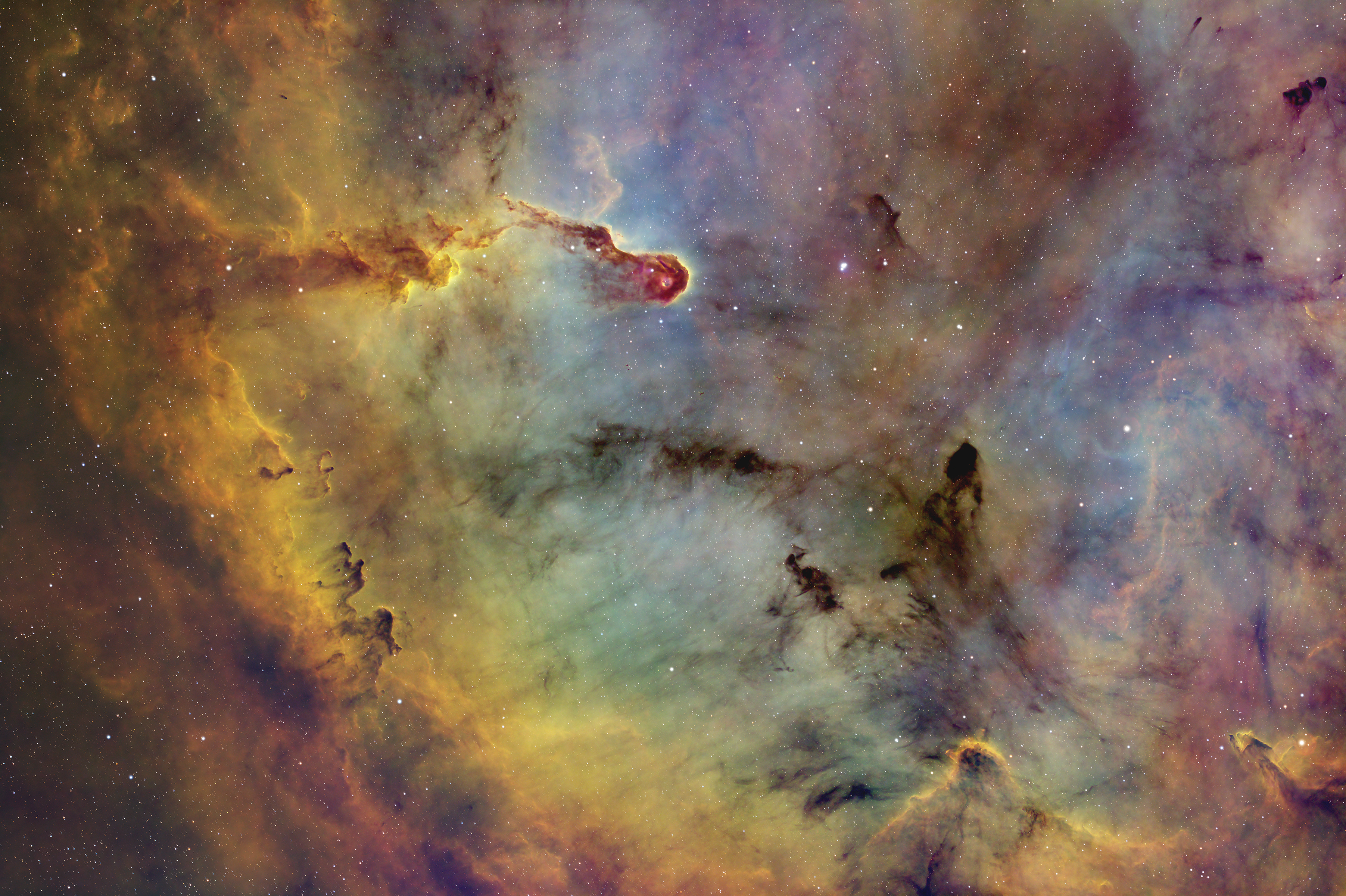
IC 1396 is a prominent emission nebula and H II region in the constellation Cepheus, situated approximately 2,450 light-years from Earth, serving as a dynamic site of active star formation illuminated by glowing ionized hydrogen gas and sculpted by dark dust clouds.[1] Spanning more than 2 degrees across the sky—equivalent to over five full Moons—it forms part of the larger Cepheus OB2 stellar association and is primarily ionized by the massive O6.5V star HD 206267 at its center. This expansive structure, covering hundreds of light-years, features intricate bright-rimmed clouds and cometary globules, including the iconic Elephant's Trunk Nebula (IC 1396A), a dense dark globule shaped by radiation pressure from nearby massive stars.
The nebula's evolution is driven by the intense ultraviolet radiation and stellar winds from HD 206267, which ionize the surrounding gas and trigger the formation of young stars within protected dense cores, such as the protostars LkHα 349 and LkHα 349c embedded in the head of the Elephant's Trunk. Observations reveal radial expansion of globules via a "rocket effect," where ablated material forms HI tails extending up to 6.5 parsecs, with velocities indicating ongoing dynamical interactions. Infrared imaging from telescopes like Spitzer has uncovered hidden young stellar objects and circumstellar disks, highlighting IC 1396 as a laboratory for studying triggered star formation and the early stages of planetary system development.
Discovered photographically in 1893 by Edward Emerson Barnard, IC 1396 has been extensively studied through multi-wavelength observations, revealing its ring-like morphology and association with the Trumpler 37 open cluster, which hosts hundreds of young stars. Its visibility from northern latitudes makes it a favorite target for amateur astronomers, while professional research continues to probe its molecular content and outflow dynamics using facilities like Subaru and ALMA.
This was my second SHO project with the relatively new scope and camera combination. It was imaged over the course of 3 nights averaging 6 hours per night.
Imaging Setup
| Gear Type | Model / Details |
|---|---|
| Telescope / Optics | Stellarvue 140 SVX 955mm f/6.7 Apo Refractor |
| Camera / Sensor | QHY 600M and QHY OAG |
| Filters | Chroma 5nm Ha SII OIII |
| Mount | AstroPhysics Mach 2 GTO |
Data & Processing
| Data (Hours) | Software | Plugins |
|---|---|---|
| 18.25 | PixInsight, Photoshop | BXT NXT SXT |
Camera EXIF Metadata
- Software
- Adobe Photoshop 27.9 (Macintosh)